

State Bureaucracy, Democratic Deficit, and the Importance of Communication
The functions of state executive agencies require effective communication, especially in the face of a volatile legislature.
I. Introduction
I started working at the South Carolina Department of Health and Environmental Control (DHEC) during my sophomore year of college. I interned for the Office of General Counsel (OGC), and I was directly supervised by the head attorney for the Environmental Quality Control (EQC) team. I loved being at DHEC— my supervisor took me to many different meetings and trials, I was given meaningful research assignments, and in the process, I nursed a growing interest and understanding of environmental regulation. However, at the end of the academic year, my temporary internship position was done.
Since that experience, I have had a variety of other jobs and internships, but I was really excited by the prospect of returning to DHEC. At the beginning of my senior year, I was able to work with my supervisor to obtain a new position as an administrative assistant for OGC, but the office had changed dramatically since I had interned there two years prior.
In May of 2023, the SC General Assembly passed bill S.399, following a report that found that DHEC was “one of the most inefficient [health agencies] in the nation — paying more money for worse results than anywhere else” (Wade 2024). Effective July 1, 2024, the bill broke DHEC into two new agencies—the Department of Environmental Services (SCDES) and the Department of Public Health (DPH), with some other DHEC services shifting to the Department of Agriculture. So, I began my senior year working for the newly formed SCDES, and I watched the repercussions of the agency split play out.
Through my experience working at the South Carolina Department of Environmental Services post-split, I witnessed how the actions of a state legislature can go against majority opinion, and how that can force the bureaucracy to act in antidemocratic or inefficient ways. Further, as I helped OGC reorganize, I realized that these issues could be at least partially addressed by clear communication within the agency. During this experience, I have learned a lot about how to create positive change in tumultuous professional settings, which has supported my efforts in pursuing the GLD pathway for Professional and Civic Engagement.
II. Repercussions of Agency Split
When I returned to the office, I saw all the things that had changed since sophomore year — the everyday workflow had been interrupted by several logistical issues. All of the public health attorneys still worked in the same hall with the rest of OGC, but all of their shared documents, resources, and Microsoft pages had been divided up. Many people who needed access to ongoing case files could not find them, and all of the systems they used to track matters they worked on were no longer functional because of the Microsoft file migration. Marshall Taylor, the chief attorney of OGC, would have used these tracking systems to provide the interim agency director, Myra Reece, with updates on OGC activities relevant to political issues she handles when working with the General Assembly (landmark cases, politically important stakeholders as parties, issues brought up by state legislators, etc.). In the absence of these systems, communication between OGC and the legislative team was breaking down. Worse still, uncertainty remained about what duties fell under what agency because of unclear wording in the original bill.
III. Volatile Legislature and Democratic Deficit
This logistical uncertainty is something that could have been—and almost was—rectified by the state legislature. Another bill, S. 915, would have merged the new DPH with a number of other executive health agencies, in an attempt to streamline the now rather complicated duties of environmental and health services. The bill would have also reassigned some of SCDES’s duties, clarifying some lines of statute that were mixed up in the split and easing the burden on overloaded bureaucrats. However, on the last day of the legislative session, the bill was stopped in a parliamentary move by one Freedom Caucus member, Rep. Josiah Magnuson (Bustos 2024). By objecting to the bill being brought up, he made it impossible for the legislation to be voted on about ten minutes before the session was adjourned sine die.
This action by Rep. Magnuson brought up questions about whether the General Assembly could come back from sine die adjournment to vote on the bill. This discussion reminded me of a guest lecture in my State Government Internship class (POLI 378) from Clerk Charles Reid of the SC House of Representatives. In my notes from the guest lecture (Artifact 1), I record how Clerk Reid defines what it means to adjourn sine die, saying “the General Assembly is adjourned without a day set to meet again and without a way to meet again per a sine die agreement.” He further clarified that special sessions could be called by the governor (which is rare and unlikely in this case). So, without a provision in the agreement for the health agency restructuring bill to be discussed in an extended session, it would be impossible for the legislature to meet on the issue that term. Further, Clerk Reid explained that changing the sine die agreement took a 2/3 vote of the General Assembly to alter—which would have been hard to arrange on the last day of session. In other words, the bill was procedurally locked up with no workarounds.
While there was some discussion about changing the sine die agreement (Bustos 2024), it would have been very difficult. It took a small majority to stall the bill, and it would have taken a 2/3 majority and an extended session to bring it back up. So, despite public opinion and majority General Assembly support, a bill that would help the health agencies after their legislatively imposed split was blocked by a few members.
In my State Government Internship class (POLI 378), we discussed the concept of democratic deficit, or the idea that popular legislation is not often passed by legislatures because of the actions or manipulation of procedure by individual legislators. According to our textbook for the class, “State policies... match majority opinion only about half the time” (Gray et al.,140). S. 915 had overwhelming support in the House and Senate of the General Assembly, and general support from the public. It could be reasonably expected that it would pass. However, a procedural move from just one member stalled the popular piece of legislation. This exemplifies democratic deficit and shows that it often does not matter what the public or executive agencies want from the General Assembly. Because of this, executive agencies like SCDES often must ignore the public and respond to the unpredictable actions of the legislature that defines their roles.
Artifact I: Notes From Charles Reid's Guest Lecture
These are my notes from Clerk Charles Reid's guest lecture on the SC General Assembly. In it, I record what he taught us about rules and procedures of the state legislature.
“The General Assembly is adjourned without a day set to meet again and without a way to meet again per a sine die agreement.”
IV. Communication is Key
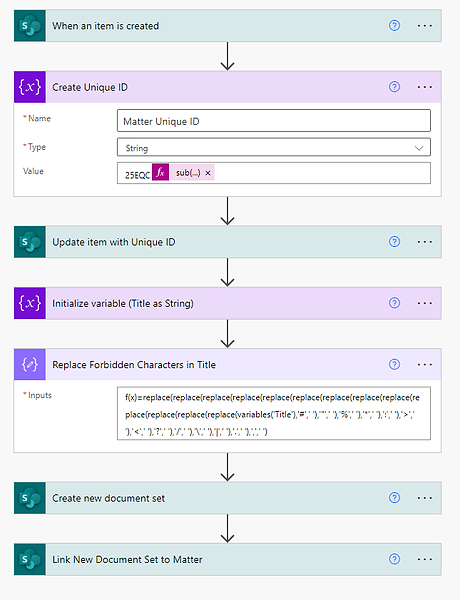
However, through my work, I noticed that as channels of communication were re-established, SCDES was becoming better able to respond to the unpredictability of the legislature and deal with the challenges that accompany that. As soon as I got my paperwork filled out on my first day at DES, I sat down with one of the attorneys who was having problems with their data transferring over from the split. When I worked at DHEC during my sophomore year, I helped to set up a new Case Management Database with weekly automated emails facilitated by PowerAutomate flows. I learned that all those automations, as well as many OGC Sharepoint sites and Microsoft Lists tracking the teams’ case files had been lost in the split, and I got started on setting everything back up. I set up PowerAutomate flows to reset the Case Management Database (Artifact 2)—first, making sure that document links are generated automatically when a new case is entered to the Microsoft List tracker, and then automating a weekly “Hot Topics” report (Artifact 3) to be sent to Marshall Taylor, the chief attorney, summarizing important updates to cases. This could be used to tell Myra Reece, the agency head, what she needed to know about OGC cases to fulfill her role with the General Assembly. This eased tensions and allowed the office to run more efficiently and responsively. In short, the unpredictability of the legislature can be met with responsiveness from executive agencies when communication within a bureaucratic office is open and prompt.
Artifact II and III: Microsoft PowerAutomate Flows and Chiefs Report
These are screenshots of flows that I made as a part of my job of SCDES. They run a case management database on the OGC team's SharePoint.
.png)
Sample main page of case management system.
Hot Topics Report Generation Flow
Automatic Document Link in Database Flow
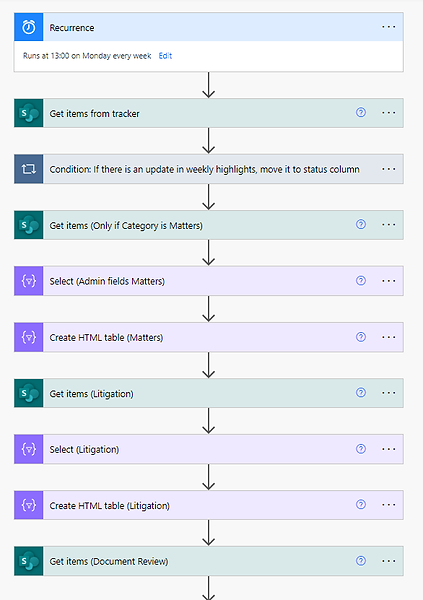

This is an example of a Hot Topics Report that would be generated weekly by the case management system and my flows.
V. Conclusion
As I continue my position at SCDES, I anticipate seeing more changes in response to the agency split. I will continue to aid in communication in OGC and help the office be responsive to unpredictable actions of the legislature. This lesson will be valuable to me as I pursue a career in environmental policy, as environmental agencies are at the center of the field. In addition, legislation is more and more often aiming to affect the activities and staffing of executive agencies, on the state and federal level. It is therefore vital that I understand the ways agencies can be impacted, and I am glad I have learned early about how to be adaptable in a workplace swayed by the state legislature.
VI. Works Cited
Bustos, J. (2024, May 11). SC’s legislative session has ended. Here are seven bills that didn’t make it. The State. https://www.thestate.com/news/politics-government/article288249335.html
Gray, V., Hanson, R., & Kousser, T. (2018). Politics in the American States: A Comparative Analysis (11th ed.). CQ Press.
Wade, H. (2024, July 1). DHEC no longer exists. With 2 new state agencies, how are South Carolinians impacted? Post and Courier. https://www.postandcourier.com/health/dhec-sc-split-public-health-environmental-protection-2024/article_be235efc-280e-11ef-b881-e701c49e111a.html
