

ATTAINING EQUITABLE AND SUSTAINABLE ENERGY INFRASTRUCTURE THROUGH INVESTMENT IN INCREASED STORAGE CAPACITY

STATEMENT OF SUBSTANTIVE ISSUE
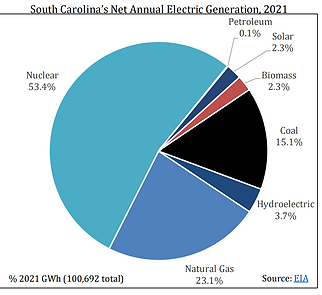
Figure 1:
The Problem
South Carolina relies largely on out-of-state nonrenewable energy reserves, despite a higher-than-average capacity for solar/renewable energy generation in-state. Further, low-income counties in South Carolina face the brunt of the state’s high energy cost burdens.
Background
Most of South Carolina’s electricity portfolio comes from nuclear power (54.3% in 2021), with natural gas and coal ranking second (23.1% in 2021) and third (15.1% in 2021). The remaining 7.5% comes from renewables like biomass fuel, hydroelectric, and solar (Center for the New Energy Economy, 2022). However, South Carolina has no in-state coal or gas production and thus at least 38% of its power is imported from out-of-state.
This portfolio is problematic in a few ways. The cost of importing drives up energy prices for South Carolina consumers (US Energy Information Administration, 2025) and reliance on fossil fuels is bad for the state’s environment (Southern Environmental Law Center, 2024). The small reserve of electricity is spread thin amongst South Carolina’s rural counties, who bear more of an energy burden—or percentage of income that a household spends on energy costs. A 6% or higher energy burden is considered a high energy burden, and the burden for low and moderate-income residents is as high as 24% in some counties in South Carolina (Southern Environmental Law Center, 2024). Further, the legislature has been looking for new ways to further increase energy reserves to support the building of data centers to bolster technology jobs in the state (Rozens, 2025).
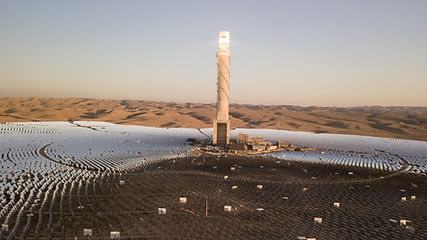
There is potential within the state for substantial renewable energy generation, though. South Carolina is 14th in the country in terms of installed capacity for solar power and continues to strive for expansion (Center for the New Energy Economy, 2022). However, general problems with solar (inconsistent seasonal production, especially during high usage periods) stop the state from increasing its proportion of the electricity portfolio.
STRATEGIC POLICY SOLUTION: ENERGY STORAGE
Energy Storage is Feasible in South Carolina
Energy storage systems are a way to “use electricity (or some other energy source, such as solar-thermal energy) to charge an energy storage system or device, which is discharged to supply (generate) electricity when needed at desired levels and quality” (Energy Storage for Electricity Generation, n.d.). These technologies are new, relatively expensive, and difficult to maintain. However, their benefits to electrical grids are huge.
Storage systems allow utilities to manage intermittent demand, and because the generation resources that provide peak power are the system’s most expensive, reducing peak demand can save consumers a significant amount of money (Center for the New Energy Economy, 2023). In the same way, storage increases the state’s overall energy capacity. These facts in conjunction would help to combat the high energy burden during peak times in low-income communities.
Further, storage technologies can both store and dispatch power, which enables better integration of all forms of renewable energy, but especially solar. Considering the state’s incredible solar potential, this could be a uniquely fitting solution for the state.
As described in my key insights, through my experience working at regulatory agencies and legislative bodies, I have seen the ways that creating policy can go wrong. Policy strategies do not live in a vacuum, and if I do not consider all branches and levels of government, or non-governmental stakeholders, it will be difficult to achieve meaningful change. Any solution that is implemented, therefore, must be (1) legislatively feasible on the local level, (2) involve active communication to and amongst state agencies, and (3) reflect understanding of federal trends restricting administrative power.
Incorporating Key Insights
Key Insight I: Local ordinances have a unique ability to negatively and positively impact socioeconomic disparities, but to create change, a coalition of legislators needs agreeable framing, political capital, and material resources.
Legislative buy-in from all levels of government is essential to this proposal. As such, by having specific strategies to engage the General Assembly, Public Service Commission, and other stakeholders, I will attempt to achieve consistent framing of the issue. By framing energy storage as a means to reduce energy burdens and promote in-state renewable generation, the plan aligns with legislators' economic priorities, increasing the likelihood of gaining support. Further, by engaging other stakeholders in this process, this proposal can additionally leverage the political capital and material resources of energy providers.
Key Insight II: The functions of state executive agencies require effective communication, especially in the face of a volatile legislature.
By discussing strategy with state regulatory agencies throughout the process of writing and implementing this legislation, a strong line of communication will be established. Through this, agencies can plan for any changes that come with increased energy storage, removing the chaos that comes with having to respond to unexpected legislation.
Key Insight III: State agencies often go beyond simply filling gaps left by federal policy in their rule-making— and in fact, they can enforce stricter regulations that reflect state-specific concerns.
The proposed plan leverages state agencies not just to fill gaps but to actively shape energy policy in a way that prioritizes South Carolina's unique energy challenges. The strategy of working closely with agencies ensures that the regulatory framework is tailored to the state's needs, particularly in in-state energy needs and its unique capacity for solar energy.
Goal of Project:
Provide for the financially feasible use of energy storage systems in South Carolina, increasing capacity for energy generated in-state in order to combat inequitably high energy burdens and promote the use of solar energy.
Stakeholder Analysis
.png)
Manage Closely (High Power, High Interest)
(Key decision-makers/implementers; must be actively engaged in strategy)
-
Public Service Commission (Legislature) - Directly involved in energy policy and regulatory oversight. Some of the members that serve on this commission will be good candidates to introduce relevant legislation to the General Assembly.
-
State Regulatory Agencies (ORS, SCDES, SCDOE etc.) (Executive) - Enforce energy regulations and oversee implementation. Regulatory agencies will carry out any grant program or incentives that the state provides. Further, they will regulate the use and maintenance of batteries in accordance with state and federal law.
-
Providers, Co-ops, Corporations, IOUs, Natural Gas Companies (Private)- Strongly interested as the bill could impact their business operations and market conditions. Providers are good candidates to own and operate energy storage systems.
Keep Satisfied (High Power, Low Interest)
(Influential but may not be deeply invested in energy storage; maintain engagement and garner interest where necessary)
-
South Carolina General Assembly (Legislature)- Hold sole power to pass necessary legislation. Their interest in energy storage specifically may be part of a broader focus on energy solutions rather than a primary concern, so it is necessary to generate more legislative interest.
-
Grid Operators (Private)- Manage grid reliability and directly influence how energy storage integrates with the power system. Their decisions affect infrastructure investment, grid modernization, and regulatory compliance.
Keep Informed (Low Power, High Interest)
(Supporters or affected groups who need updates; can advocate for or against policies but have limited direct influence)
-
Battery Manufacturers (Private)- They have a strong interest in market growth and policy incentives but limited direct influence on regulatory decisions.
-
Individual Consumers (Constituents)- The public has a vested interest in how energy storage affects rates, reliability, and sustainability but lacks direct influence. They can help focus legislative attention.
-
Environmental Nonprofits (SCELP, SCCV, SELC, etc.) (NGO)- They are highly interested in energy storage's role in clean energy and sustainability but have limited power to directly influence legislative outcomes. They can help focus legislative attention.
Monitor (Low Power, Low Interest)
(Stakeholders with minimal direct influence or stake; periodic updates may be enough)
-
Industry/Business Large Energy Consumers (Private)- Businesses that depend on energy reliability and affordability will want to stay informed. This category includes prospective data centers that would be more able to come to the state with increased capacity.
-
Local Governments (Municipal/County Governments)- While they may not have direct control over large-scale energy policy, they influence zoning, permitting, and incentives for energy storage deployment.

SPECIFIC PLAN FOR IMPLEMENTATION
Timeline for Action
.png)
Evaluation
The success of my plan can be evaluated by three metrics: legislative outcomes, impact of batteries on energy burden, and change in energy portfolio.
-
Legislative outcomes: If this plan is successful, the legislature will act in favor of energy storage solutions.
-
Electricity Portfolio: If the plan is successful, a higher proportion of South Carolina’s portfolio will be solar energy generated in-state.
-
Energy burden: If the plan is implemented successfully, the energy burden in low-income counties will be decreased, because energy will be cheaper and there will be less impact from high-demand periods.
Works Cited
Center for the New Energy Economy. (2022). State brief: South Carolina. https://cnee.colostate.edu/wp-content/uploads/2022/08/State-Brief_SC_July_2022.pdf
Center for the New Energy Economy. (2023). Energy storage. https://cnee.colostate.edu/wp-content/uploads/2023/09/Energy-Storage.pdf
Energy storage for electricity generation - U.S. Energy Information Administration (EIA). (n.d.). https://www.eia.gov/energyexplained/electricity/energy-storage-for-electricity-generation.php
Rozens, T. (2025, January 27). S.C. House considers energy bill that would support economic development - Daily Energy Insider. Daily Energy Insider. https://dailyenergyinsider.com/news/47026-s-c-house-considers-energy-bill-that-would-support-economic-development/
Southern Environmental Law Center. (2024, August 28). Energy equity can be a reality in South Carolina - Southern Environmental Law Center. https://www.selc.org/news/energy-equity-can-be-a-reality-in-south-carolina/
US Energy Information Administration. (2025, February 20). South Carolina profile. https://www.eia.gov/state/print.php?sid=SC